


The polar vortex is doing something extraordinary
The polar vortex is doing something extraordinary

Doyle Rice and Dinah Voyles Pulver, USA TODAYTue, November 3, 2026 at 1:40 PM UTC
284
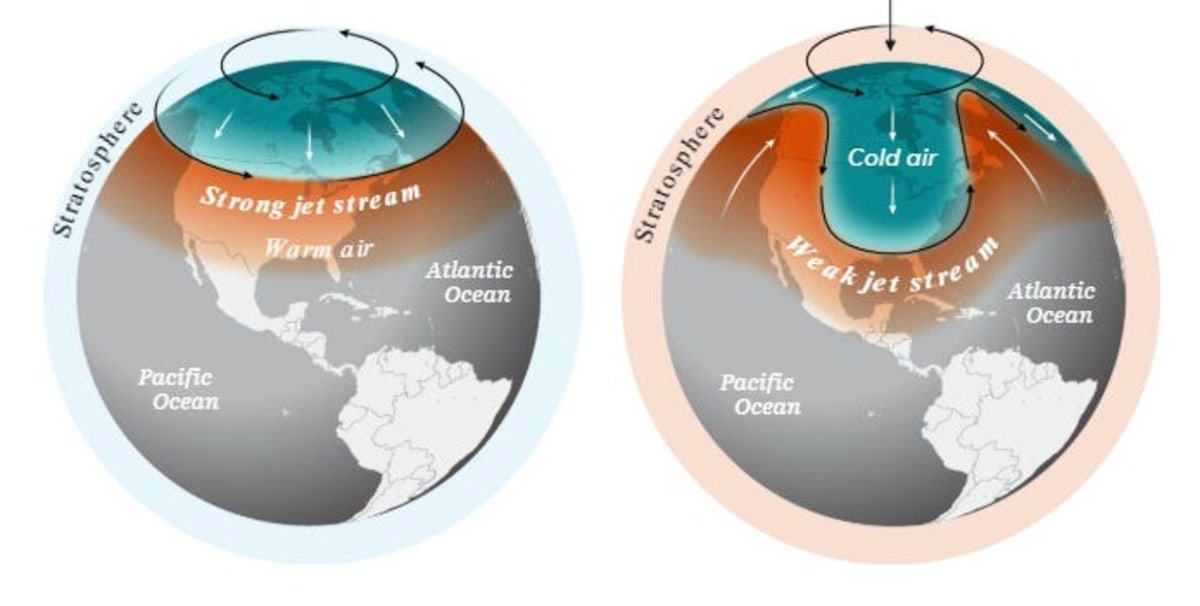
Something unusual is happening in the skies above the Arctic, but will it have any impact on our weather here in the United States?
Our favorite wintertime punching bag, the polar vortex, is being disrupted in a climate process known as "sudden stratospheric warming,"(SSW), which could eventually lead to an outbreak of frigid air across much of the United States at some point over the next few months.
What's unusual is that the SSW is occurring so early in the season. Indeed, forecast confidence has risen recently that the polar vortex will undergo an extraordinarily early major disruption early in November.
Meteorologists already are seeing the polar vortex “become stretched out and splitting into two smaller vortex lobes,” said Laura Ciasto, a meteorologist with NOAA’s National Weather Service. It has the potential to be the earliest sudden stratospheric warming event since 1958, when reliable records began, Ciasto wrote in an email to USA TODAY.
Whether that disruption translates into significant cold or snow in the United States later in November or December is much less certain.
"These are very interesting times for the polar vortex and likely for our weather. This will be very interesting to watch unfold!" said polar vortex expert Judah Cohen of the Massachusetts Institute of Technology in an e-mail to USA TODAY.
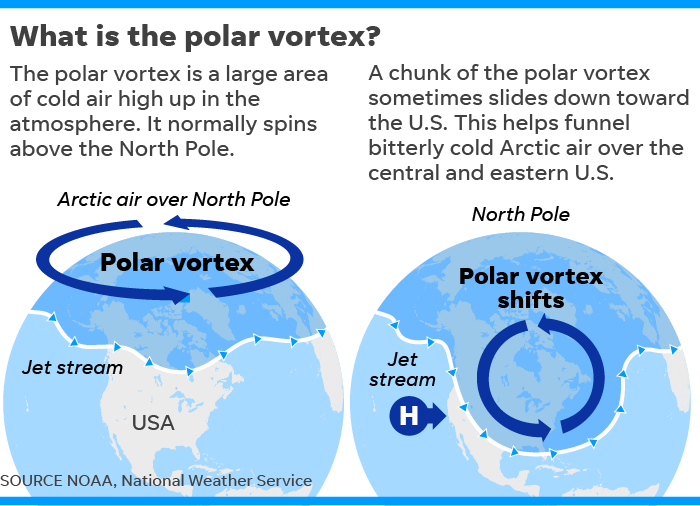
What is the polar vortex?
The polar vortex is a gigantic, circular area of cold air high up in the atmosphere that typically spins over the North Pole (as its name suggests). It's strongest during the winter and usually weakens or even disappears in the summer.
Its position can determine what part of the U.S. that Arctic air will invade. Also, the polar vortex is not a synonym for "cold snap," according to the Polar Vortex Blog at Climate.gov, and it’s not the only weather pattern to blame for blasts of cold air.
Meanwhile, the phrase "polar vortex" has captured public attention and is now often misused to describe short-term bouts of frigid weather, experts told USA TODAY last year. "Weather can happen regardless of what the stratosphere is doing," said Isla Simpson, a scientist with the National Center for Atmospheric Research.
What is 'sudden stratospheric warming'?
Sudden stratospheric warming (SSW) is a dramatic warming of the stratosphere above the Arctic, typically 10 to 30 miles above Earth, that can disrupt or even temporarily reverse the normal west-to-east winds of the polar vortex.
The stratospheric polar vortex generally keeps the coldest air bottled up near the pole in the stratosphere, some 20 miles up in Earth’s atmosphere, said Andy Hazelton, an associate scientist at the University of Miami. But sometimes, large waves in the atmosphere can push up from below and knock the vortex off balance. That causes air over the pole to warm and its westerly winds to slow down or reverse direction, Hazelton wrote in a blog post this week. The post on Brightband.com included analysis by scientists with Brightband, a technology company that says it's using artificial intelligence to improve weather forecasts.
Advertisement
This sometimes allows very cold Arctic air to spill farther south into North America, Asia or Europe several days or weeks later.
What's going on now?
With the event meteorologists are now watching, the polar stratospheric winds could reverse direction from westerly to easterly sometime between November 6-10, Ciasto said.
In the records since 1958, only two other warming events happened in November, Ciasto said. Typically the events occur in January-March. They are less common in November, she said, because the polar vortex is still growing, with less wave energy propagating into the stratosphere to disrupt it.
Typically the events increase the chances of below-normal temperatures across the eastern U.S. and northern Europe, but those events in January, February or March occur when Arctic temperatures “have had time to get quite cold,” she said. “In November, there hasn't been as much time so there's less cold to source a cold-air outbreak.”
The Arctic as a whole at the end of October was about 8 degrees warmer than the 1990–2019 normal, while Alaska and the Yukon was about 13 degrees warmer, said Hazelton. The only real pool of cold air was over Eastern Siberia, Hazelton said.
How (and when) will all this impact the weather in the US?
Ciasto said it's important to remember the polar vortex is often not the only player in the atmospheric playground. This is especially true this winter with the very strong El Niño, Ciasto said. "How these two play together or compete will definitely influence what we feel at the surface in the next month."
While the sudden warming events have a reputation for causing some of the “most memorable cold outbreaks in recent years,” Hazelton said the AI model ensemble from Brightband indicates this event could be weak and short-lived, settling back toward the pole in late November with little impact on the United States.
Cohen previously told USA TODAY the most certain impact is a period of milder weather to eastern North America, probably for much of November.
"Usually it takes two weeks (but recently it seems to take much longer) for the impacts of the SSW to impact our weather, so that puts it as early as late November but more likely in December and could even be delayed until January," Cohen said. "The downward influence of the SSW in my opinion is more likely to impact the weather of Northern Europe and/or Northern Asia than the eastern United States."
In recent years, the impacts from SSWs in the eastern United States have been heavily skewed to resulting in overall milder weather across the eastern US in stark contrast to expectations, Cohen said. "The last El Niño in 2023-24 featured two SSWs and it was a very mild winter in the eastern US and may have even been record mild. In short lots of uncertainty!"
Dinah Voyles Pulver and Doyle Rice are national correspondents for USA TODAY, with a focus on weather and climate.
This article originally appeared on USA TODAY: The polar vortex is doing something extraordinary
Source: “AOL Breaking”
